Avatar photo

Sarah Stephen

Lecturer in Strategy and Business Ethics at the University of Liverpool, United Kingdom. She holds a PhD in Economics, specialising in Management, from the University of Lausanne, Switzerland. Her research focuses on the intersection of society, the environment, and organizations, particularly in relation to environmental responsibility, ESG and responsible investing, climate action, and ethical decision-making.

In pursuit of fairer capitalism: Making markets work for all

A long-run macroeconomic trend on worldwide economic progress will come as little comfort to those who are left behind, face poverty, injustice, extinction, or even simply suffer short run losses. Instead of waiting for long-term changes to unfold, we need to find and enable mechanisms that can help us short-circuit the development process and make markets work better for all even in the short run. This essay outlines three challenges that need to be confronted to make markets work for all.


Which kinds of company boards support more socially and environmentally friendly practices?

Companies’ boards of directors directly influence the social and environmental policies pursued by the corporate world, which plays a major role in the quality of life of everyone in society. Boards with more directors on them, which include more independent directors and more women, and who appoint a CSR board committee, are more likely to pursue socially and environmentally friendly practices.

Business & Society in social media: Glimpses into 2021 and the future

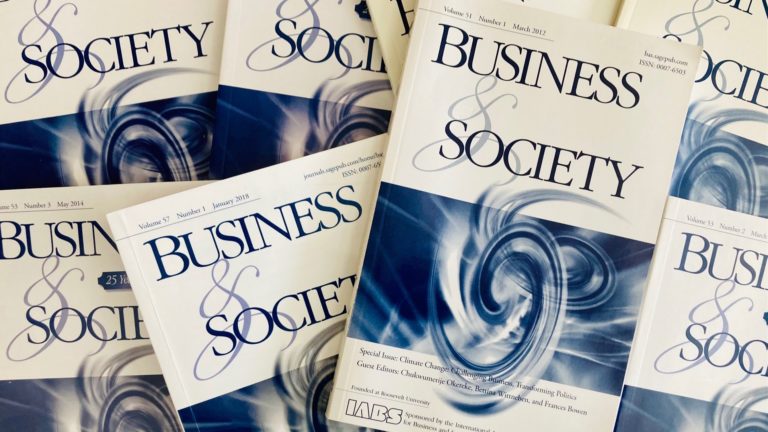
The main goal of Business & Society’s (BAS) social media presence is to support the dissemination of business and society research among scholars, students, and practitioners. By promoting the visibility of BAS publications and sharing any information that might be useful to our community, we want to inspire researchers, facilitate knowledge creation, and increase the social impact of the journal.

Ode to a Mentor: Remembering John F. Mahon

Remembering John Mahon, who co-founded the International Association for Business and Society (IABS) and was a former editor of Business & Society. John championed evidence-based research examining how businesses, politics, and corporate responsibilities have evolved, thereby helping to create a foundation upon which scholars today examine integrative ESG, social impact, and social enterprise strategies, among other topics.

Managing Tensions in Collaborative Cross-Sector Business Models for Sustainability

Our study examines the pre-pandemic path of “blood, toil, tears and sweat” that it took to develop telecare in Spain through collaborative cross-sector business models that included government, businesses, nonprofits, and informal actors under the leadership of the Spanish Red Cross. Specifically, we explore in which ways tension management contributed to the development of telecare as a sustainability innovation.