
Organizational Corruption and Wrongdoing in the Era of Grand Societal Challenges: Research and Agenda
Organizational corruption and wrongdoing sit at the heart of climate, health, democracy, and the other grand challenges of our time.
Glencore, Samsung, Siemens, Volkswagen, Binance. The names change, but the story keeps repeating. Decades of research, laws, and compliance programs have not eliminated organizational corruption.
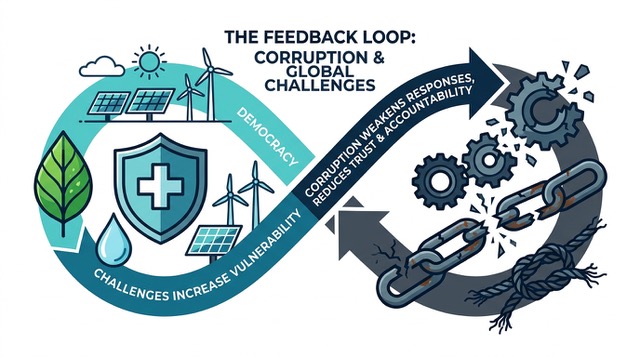
The short answer is that they feed each other. Corruption makes it harder to tackle problems like climate change, and those same problems open new doors for corruption. Here is what that means and why it matters.
For a long time, corruption has been treated as a localized failure of individual morals or a mechanical breakdown in internal controls. Better auditing, stricter codes of conduct, and harsher penalties were supposed to fix it. While those measures matter, they miss a bigger reality: organizational wrongdoing actively undermines how societies respond to their defining crises. At the same time, those very crises create new pressures, funding streams, and justifications for misconduct.
In our introduction to a new Special Issue of Business & Society on corruption and wrongdoing, we @Stefan Schembera, @Armando Castro, @Don Lange, @Kathleen Rehbein, @Punit Arora look closely at this two-way relationship, asking: how are organizational corruption and wrongdoing linked to the grand societal challenges humanity faces.
From Bad Apples to Bad Barrels to a Wider Societal Problem
Our understanding of corruption has shifted a lot over the past three decades. We have moved beyond the familiar caricature of an individual slipping a bribe under the table. Management and organization research has shown how corporate cultures, everyday routines, unexamined incentives, and power dynamics can make misconduct feel normal, necessary, or even virtuous to the people inside the organization.
Yet, even this expanded view usually treats corruption as an internal affair, quarantined inside the walls of the offending company.
When you look at it through the lens of business and society, that boundary dissolves. Today, corruption is understood to take many forms beyond bribery from money laundering, tax evasion, collusion, manipulated ESG metrics, greenwashing, through to serious human rights abuses. A manipulated emissions report does more than break a regulatory rule but directly sabotages global climate commitments. Diverted development funds hollow out public health initiatives.
Misconduct is not “just” a damage to the corporate balance sheet but it corrodes public trust and fractures our collective ability to act.
Corruption as an Economic Cost
Early work treated corruption as “sand in the wheels” of commerce. Bribery and rent-seeking raised the cost of doing business and held back investment and growth. Companies were mostly seen as bribe payers or victims of corrupt officials.
Bad Apples
When management scholars joined in, attention moved to the organization. The first instinct was to blame individuals with poor morals and fix the problem through better hiring, training, and controls.
Bad Barrels
Scandal after scandal showed that good people can be pulled into wrongdoing. Research turned to the cultures, routines, and incentives that make misconduct feel normal, necessary, or even virtuous.
A Business-and-Society Lens
Today, corruption is understood to take many forms beyond bribery: money laundering, tax evasion, collusion, manipulated ESG metrics, greenwashing, and serious human rights abuses. Many of these sit in a gray zone between what is legal and what is legitimate.
Each step added something. But one gap remained: corruption was still mostly studied as an organizational problem, cut off from the larger crises societies are trying to solve.
And the street runs both ways. When major crises hit, whether it’s a pandemic, a supply chain shock, or a rapid technological shift, they bring urgency, uncertainty, massive flows of capital, and immense pressure to deliver results fast. Where oversight is stretched thin and responsibilities are muddy, those conditions open the door wide to opportunistic wrongdoing
A Framework for the two-way Street
In our introduction, we propose a four-part framework that links corruption to grand societal challenges:
Impact on Global Progress
How corruption inside organizations holds back, distorts, or reverses progress on big problems. Corporate wrongdoings—whether a bribe to allow illegal logging, a manipulated emissions figure, or heavy fossil-fuel lobbying at climate talks—may look narrow, but the damage distorts decisions and derails collective responses to societal problems, bleeding far beyond immediate victims.
Crisis Conditions & Pressure
How big problems or massive transformations change the conditions for misconduct. Crises bring urgency, uncertainty, and change the incentives and justifications for misconduct, often rewarding speed and agility at the expense of oversight, making rule-bending look like sensible adaptation from the inside. Think of face-mask scams during COVID-19, or fraud riding the wave of cryptocurrency.
Responses & Reform Lastingness
How we respond matters too. Regulators, investors, civil society, collective action, technology, and internal reforms all dictate whether misconduct gets seen, who is held responsible, and whether reforms last once the spotlight has moved on.
Navigating Gray Zones
How misconduct is interpreted. Not every business practice is clear-cut and straightforward to classify. Many transgressions live in gray zones, such as lobbying, gifts, “service fees”, hiring of relatives, or hurried ESG reporting. They may be lawful and yet contested, or defended in one (e.g., business or cultural) context as necessary business practice while appearing irresponsible or harmful in another. Understanding these boundaries requires attention to context, power, and consequences, not simply to whether a formal rule has been broken.
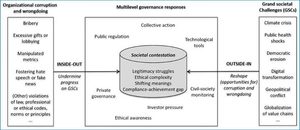
The corruption–grand societal challenges nexus · Figure 1 reproduced from the article
What the Seven Articles of this Special Issue Show
The seven papers in the Special Issue each take on a different piece of this puzzle and explore these dynamics across remarkably different institutional and organizational settings as varied as an NGO in Bangladesh, FIFA, S&P 500 boardrooms, and Danish police call centers. Four examples illustrate the breadth of the collection.
Muurlink et al. (2026)
INSIDE-OUT
Examines coastal Bangladesh, where an insider built what they describe as a “parasitic enterprise” within an international NGO, diverting resources while the organization retained its respectable public image. The case draws attention to wrongdoing operating inside organizations whose stated purpose is to address social needs View Research Article →
Mitnick (2026)
INSIDE-OUT
Shows that fraud follows repeatable patterns. Five core mechanisms (demanding, taking, diverting, steering, and assuring) produce eight recurring types of market manipulation. View Research Article →
Li et al. (2026)
INSIDE-OUT
Reveals how corruption fugitives carry reputational damage across borders. heir presence hurts the image of their host country and of companies based there. View Research Article →
Assefa et al. (2026)
OUTSIDE-IN
Examines firms across 94 developing countries using World Bank data and finds that women-led firms are less likely to pay bribes. Part of this difference relates to women-led firms being targeted with demands for illicit payments less often, pointing to how external environments actively shape compliance realities. View Research Article →
Gibel et al. (2026)
GOVERNANCE
Traces the trajectory of FIFA’s anti-corruption reforms from 2016 to 2024. Their analysis highlights the difficulty of sustaining reform when external pressure fades and established patronage practices have not been fundamentally displaced. Formal reforms do not necessarily eliminate the conditions that enable misconduct to recur. View Research Article →
Fewer et al. (2026)
GOVERNANCE
Shows that whether a board fires its CEO after misconduct depends on company identity. “Individualistic” firms blame the CEO, whereas “collectivistic” firms see a broader system failure. View Research Article →
Wåhlin-Jacobsen & Mikkelsen (2026)
CONTESTED BOUNDARIES
A micro-level study of police emergency-call centers revealing how staff constantly negotiate with callers in real time where the line between acceptable practice and misconduct lies. Their contribution draws attention to everyday judgments through which standards of conduct are interpreted and enacted. View Research Article →
Together, they show that corruption is rarely a simple one-off rule-break. It can be a patterned strategy, embedded in organizational routines, sustained despite formal reforms, and negotiated through everyday human infteraction and decision. The collection in our Special Issue offers different ways of examining these dynamics.
Questions for the Next Wave of Research
The Special Issue also points towards questions that deserve further attention.
What we still don’t know: the collection says most about how corruption damages progress and how reforms fail, but says much less about how crises reshape corruption.That is where we see the biggest openings for new work:
When does lobbying on climate policy become corrupt obstruction? Can new routines, like recorded online meetings, make crisis response cleaner? How should firms handle authoritarian or conflict settings?
Are ESG pressures reducing corruption, or just repackaging it in nicer language? When rules spread responsibility across firms, regulators, investors, and civil society, when does shared responsibility become no one’s responsibility?
It cuts both ways. Blockchain, AI, and online platforms open new avenues for fraud but also new tools for transparency and monitoring.
We need to know how small deviations become routine, how corrupt networks form and break apart, and whether small, family-owned, or entrepreneurial firms face distinct risks.
Big data can reveal patterns, but more data is not the same as better understanding. Some wrongdoing leaves few traces, and the most visible kinds can look more common than they are.
Why this matters beyond academia
The main practical lesson is that anti-corruption should not be treated as a narrow compliance box to tick. Compliance and enforcement still matter, but they are not enough. If corruption shapes climate action, public health, trust in democracy, and peace, then fighting it is part of the basic infrastructure for solving shared problems.
should treat corruption as a strategic and societal risk, not just a legal one, and link it to climate commitments, human rights, supply chains, and digital accountability.
should look past disclosures and ask whether ESG systems actually change behavior or only polish appearances.
need rules built for crisis conditions and complex supply chains, not only stable, domestic settings.
can make hidden harms visible, even where formal enforcement is weak.
International organizations can can follow UNODC’s call to mainstream anti-corruption across all SDGs, rather than leaving it to SDG 16 alone.
This last point is close to my own work in development evaluation. As the world looks past 2030, the next sustainable development agenda should treat anti-corruption as a condition for progress on every goal. We need to measure more than bribery and track real results, asking whether they help prevent harm, preserve accountability, and enable meaningful progress, not just whether policies exist on paper.
The Bottom Line
The bottom line is simple: Anti-corruption is about protecting our ability to act together. Corruption is not a side issue in the study of grand challenges. It is central to whether our collective responses succeed or fail.
Read the full article
Schembera, S., Castro, A., Lange, D., Rehbein, K., & Arora, P. (2026). Understanding and Confronting Organizational Corruption and Wrongdoing in the Era of Grand Societal Challenges: Past, Present, and Future Perspectives. Business & Society, 0(0). https://doi.org/10.1177/00076503261490684