
For over two decades, Corporate Social Responsibility (CSR) has served as the guiding framework for how businesses engage with society’s biggest challenges, from climate change and inequality to corporate governance and democracy. It became so widely adopted that many considered it close to a universal norm, with ESG criteria moving from a peripheral concern to a central pillar of corporate strategy.
That consensus now appears to have unraveled.
A new special issue of Business & Society, guest edited by Dorothee Maria Winkler and David Risi (Bern University of Applied Sciences), Christopher Wickert (Vrije Universiteit Amsterdam), and Onna Malou van den Broek (Copenhagen Business School), with Punit Arora (CUNY) as the journal’s editor, calls for papers to explore what happens to CSR when the political ground underneath it shifts.
- Why Now?
The signs of change are hard to miss. Major U.S. companies, including Meta and Amazon, rolled back diversity, equity, and inclusion (DEI) initiatives almost overnight; reversals so swift that some scholars now question whether these commitments were ever more than symbolic. In Europe, the European Parliament voted in late 2025 to significantly scale back corporate sustainability due diligence rules, exempting most companies in favor of rearmament and competitiveness priorities. Meanwhile, ESG funds that once excluded weapons manufacturers on ethical grounds are increasingly repositioning “defense” as a legitimate, even virtuous, investment category, framed around protecting democracy and freedom.
These aren’t isolated incidents. They reflect a broader realignment: businesses and governments alike are recalibrating around national interest and security rather than the universal social and environmental goals that once defined responsible business.
- The Core Question
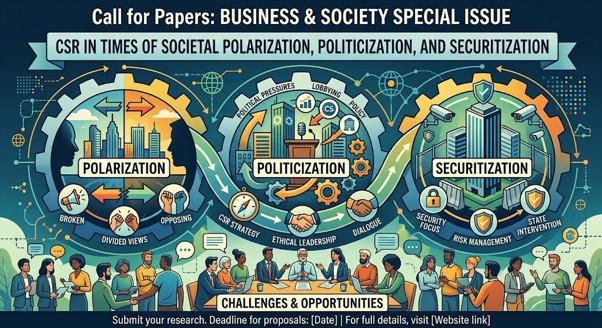
The special issue is organized around one central question: What does Corporate Social Responsibility entail in an era of societal polarization, politicization, and securitization?
It explores this through three interconnected lenses:
Polarization. As societies split along political and cultural lines, companies face pressure to maintain legitimacy across increasingly divided stakeholders. Does CSR help counter populist and illiberal politics, or does it just fall in line with whoever holds power?
Politicization. CSR is increasingly used as a tool of political signaling rather than genuine social progress; a phenomenon some researchers call “reverse CSR.” This raises deeper questions about whether CSR is diffusing from more autocratic contexts, where it has long served political rather than social ends, into democratic ones.
Securitization. As national security concerns take center stage, CSR is being redefined within industries like defense and technology, including questions about the role of business in enabling surveillance and state power under the banner of protecting national interests.
- Why This Matters
For years, CSR research operated on the assumption of a broadly shared consensus about the responsibilities businesses owe to society. This special issue challenges that assumption directly, asking researchers to grapple with a more fragmented reality; one in which CSR looks different depending on the country, industry, and political context you’re examining.
The editors are inviting interdisciplinary contributions spanning political science, sociology, communication, and history, recognizing that understanding this shift requires a lens beyond traditional management.
- Contribute
Researchers working at the intersection of business, politics, and society are encouraged to submit. Full details on themes, guiding questions, and submission requirements are available in the complete call for papers.
Submission window: August 2027