
By Punit Arora, Hari Bapuji, Sven Kunisch, and Céline Louche
What should a literature review do when the literature itself does not agree?
This question is relevant for business and society scholars. Research on sustainability, climate change, diversity, inequality, human rights, corporate responsibility, and other societal challenges is often large and fragmented. More importantly, disagreement in these fields is not always something that can be resolved by collecting more evidence.
At the 2026 Academy of Management Annual Meeting in Philadelphia, these questions were at the center of a panel symposium on the role of review articles in scientific knowledge production. The panel brought together editors from several leading management journals to discuss what makes an impactful review article, different approaches to reviewing literature, and the opportunities and limitations created by artificial intelligence.
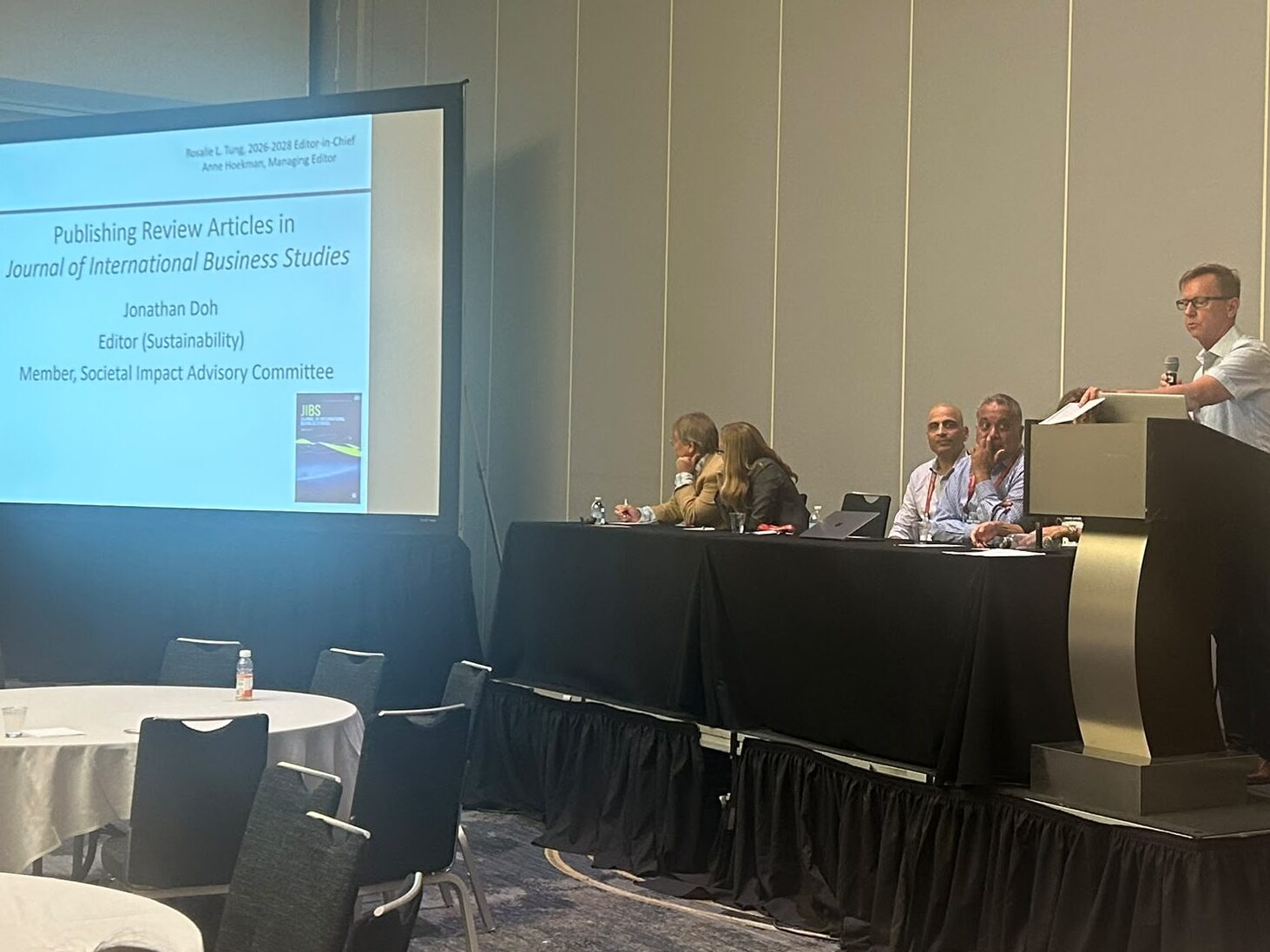
Representing Business & Society, Co-Editor-In-Chief Punit Arora shared ideas from an editorial developed together with Hari Bapuji, Sven Kunisch, and Céline Louche: Turning the Prism to Expand the Spectrum: Literature Reviews in Contested Domains.
Their central message: when reviewing a contested literature, scholars should not only ask “What does the literature say?” They should also ask “Where does it disagree, why does it disagree, and whose perspectives might be missing?”
From a photograph to a prism
Traditional approaches to literature reviews can be compared to taking a photograph. The goal is to provide a comprehensive and accurate picture of the existing literature: identify relevant studies, analyse them systematically, and synthesize what is known.
This remains important. But in contested domains, it may not be enough.
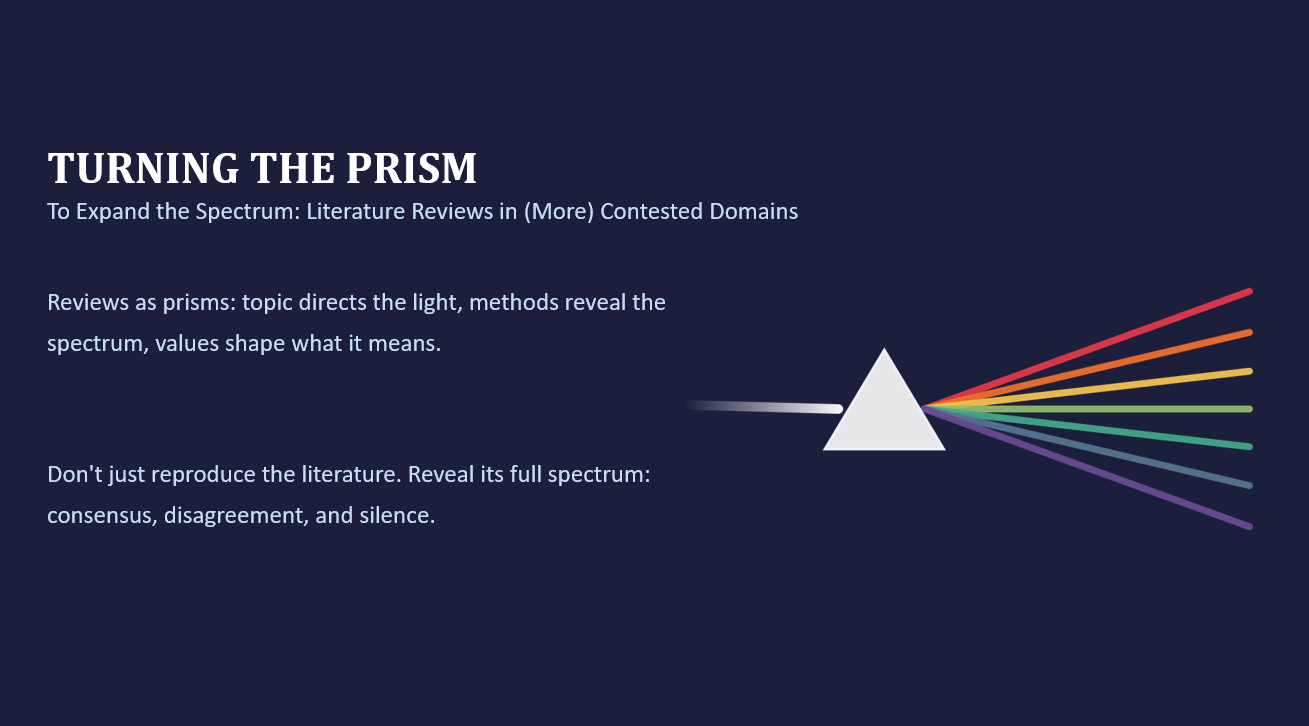
Arora and colleagues instead propose thinking of a literature review as a prism. A prism does not simply reproduce the light that enters it. It reveals the different wavelengths contained within that light.
A review can do something similar: it can reveal its consensus, disagreement, competing assumptions, and silences.
This distinction matters because contestation can take different forms. Scholars may disagree about empirical findings, use competing theoretical explanations, hold different normative positions about what outcomes are desirable, or even disagree about what should count as valid knowledge.
These differences cannot necessarily be solved in the same way. More evidence may help resolve an empirical uncertainty. It is less likely to resolve a disagreement rooted in competing values or fundamentally different assumptions about knowledge.
Looking for disagreement, not hiding it
The framework highlights a risk in applying conventional review approaches to contested research: the search for synthesis can inadvertently create false consensus.
A technically rigorous review might, for example, predominantly represent one theoretical tradition while overlooking competing traditions. Minority perspectives might be acknowledged but given little analytical weight. Or studies using very different concepts and contexts might be combined as if they were directly comparable.
For business and society research, these are important concerns. Many of the phenomena studied in the field are themselves contested, and relevant scholarship can be dispersed across disciplines, countries, languages, journals, and forms of knowledge.
The frontier of knowledge may therefore sometimes be found precisely in the outliers: anomalous findings, dissenting perspectives, and voices that have received less attention.
A good review should make these tensions visible rather than smoothing them away.
Leadership, inclusion, and impact
To help researchers navigate this challenge, the proposed framework considers three elements of a literature review, its topic, methods, and utility, through three guiding values: leadership, inclusion, and impact.
Leadership means entering a conversation where there is productive tension and using the review to move that conversation forward. The goal is not simply to identify a large body of research, but to reveal debates that the field has not yet clearly recognized.
Inclusion asks researchers to consider whose knowledge becomes visible through the review. Choices about databases, journals, languages, disciplines, and types of evidence are not neutral. Researchers should therefore ask whose perspectives are represented, whose are absent, and whether those absences influence the conclusions of the review.
Impact asks what becomes possible once the disagreement has been mapped. A useful review can help scholars, practitioners, communities, and policymakers understand what is relatively established, what remains uncertain, and where disagreement stems from competing assumptions or values.
This also means accepting that a literature review does not always need to resolve a debate. Sometimes, clearly showing why a debate remains unresolved is itself an important contribution.
And what about AI?
The discussion becomes particularly timely as generative AI and large language models become increasingly integrated into research workflows.
AI tools can help researchers search, organize, classify, and navigate increasingly large bodies of scholarship. But the prism perspective also highlights why literature reviews cannot simply become automated exercises.
Deciding what belongs in a review, determining whether two studies are genuinely comparable, recognizing whether a disagreement is empirical or normative, identifying missing voices, and judging what a field should do next all require scholarly judgment.
This is particularly important in contested domains. An AI-supported synthesis may reproduce the dominant patterns in the literature while making marginalized perspectives even less visible. Apparent consensus can therefore be misleading if researchers do not critically examine how the corpus was constructed and how competing claims were interpreted.
The challenge is not to avoid new tools, but to use them without outsourcing the intellectual responsibility of reviewing.
Revealing the full spectrum
For scholars preparing literature reviews in business and society research, the message from Philadelphia is therefore not simply to make reviews more comprehensive.
It is to make them more reflexive about what they reveal and what they obscure.
Before completing a review, researchers might ask: Have we represented disagreement fairly? Are we treating different phenomena as comparable when they may not be? Whose knowledge is absent from our corpus? Are we distinguishing uncertainty from genuine contestation? And, ultimately, what does mapping these tensions allow scholars or practitioners to do differently?
A literature review should not merely reproduce the literature that already exists.
Sometimes, its contribution lies in turning the prism, and revealing the spectrum that was there all along.