
Business does not have to choose between purpose and profit. In his first keynote, followed by an integrative workshop, in Poland, Freeman made the case that stakeholder capitalism is a better story about business because it integrates rather than divides. Here are the key takeaways.
By Anna Sławik
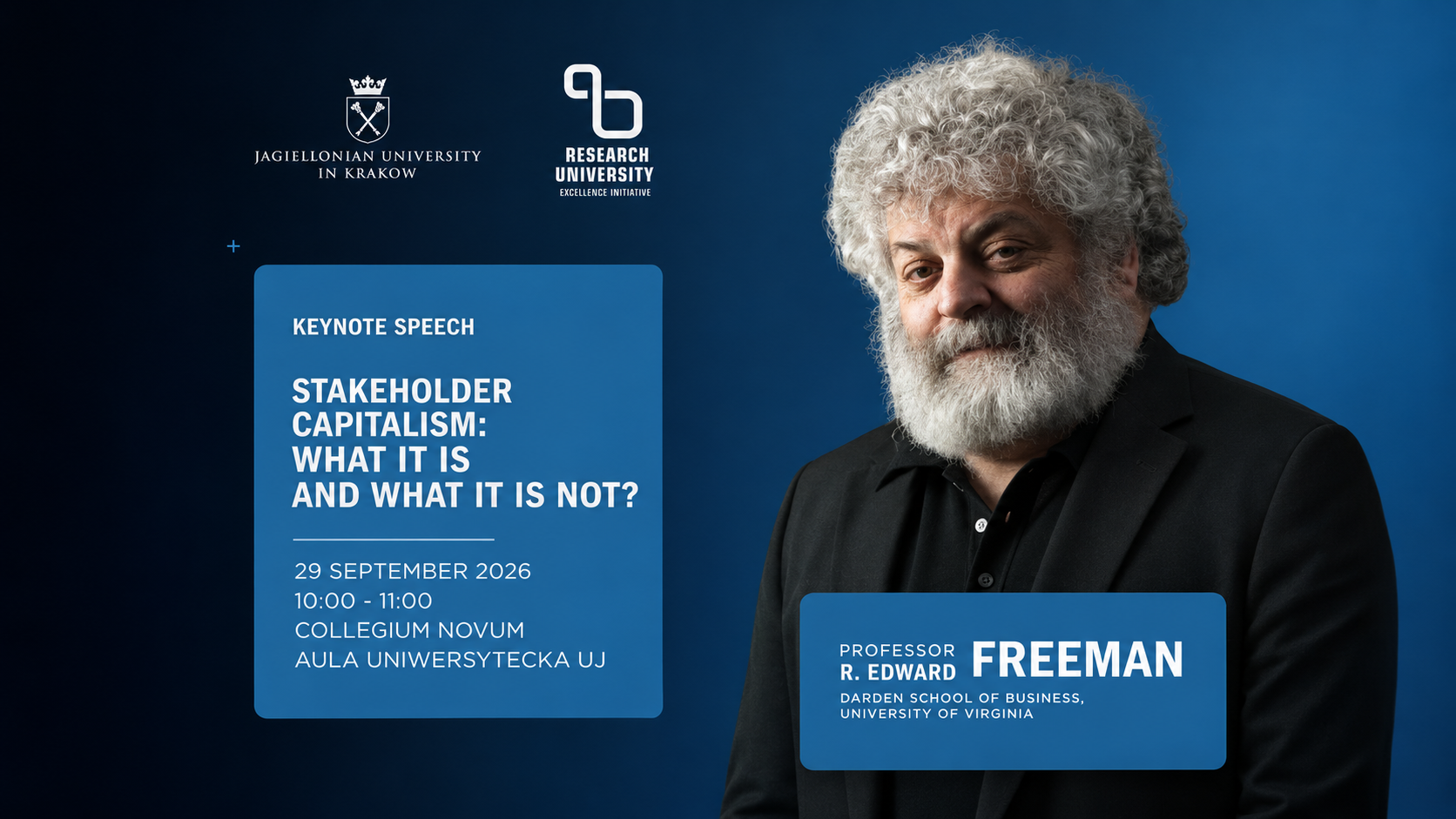
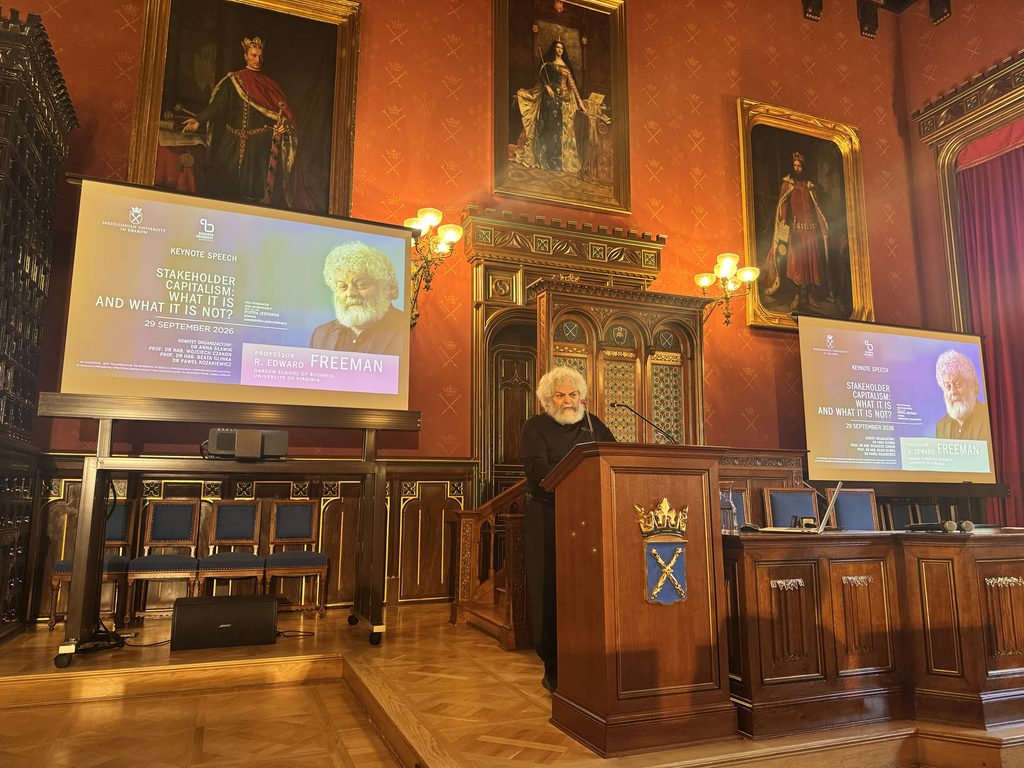
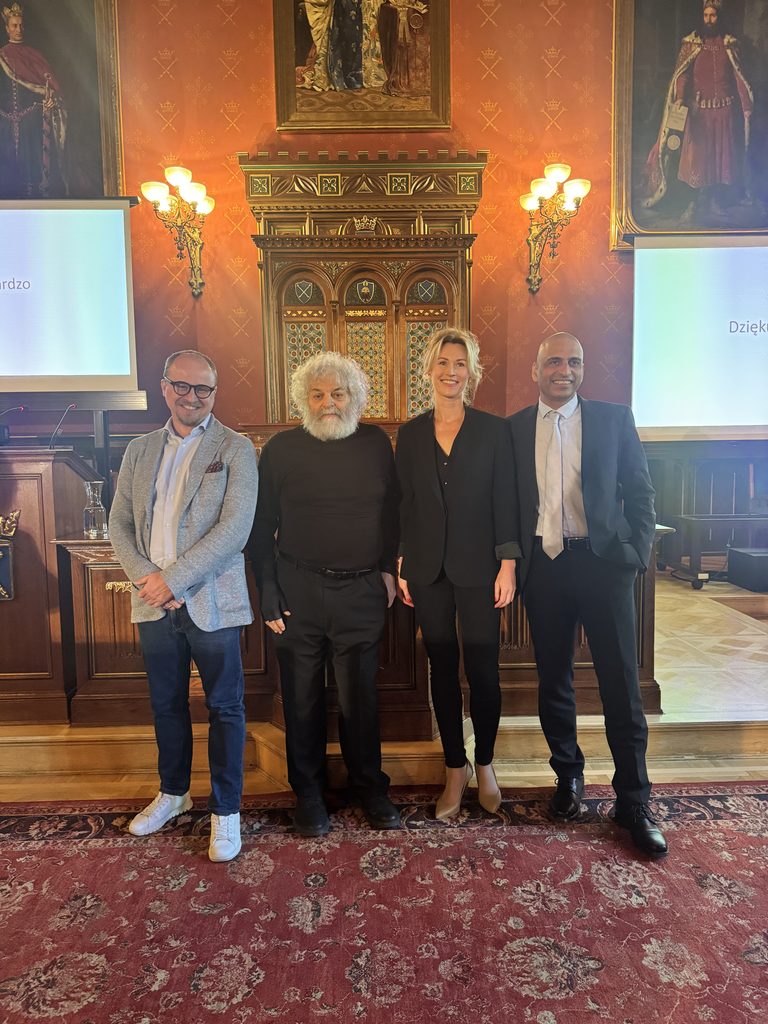
“There’s a better story to tell” was the leitmotif of the keynote “Stakeholder Capitalism: What It Is and What It Is Not,” delivered by R. Edward Freeman of the University of Virginia’s Darden School of Business on September 29, 2026, at Jagiellonian University in Kraków.
Why we need stakeholder capitalism
The perfect storm of recent decades – the global financial crisis, persistent discrimination, global warming, wars, and terrorism, to mention just a few, and, on top of it all, the pandemic – has demonstrated that we cannot continue with business as usual.
At the same time, we’ve been flooded with fads and buzzwords proclaiming responsibility, sustainability, justice, consciousness, and similar values. They were meant to help us swim against the current, but it seems we’ve been merely treading water.
The thoughts, initiatives, movements, rankings, and numerous metrics generated by the many attempts to put these concepts into practice are well-intentioned and deserve credit. And yet there is the impression that we try to measure something which is unmeasurable. We try to justify, in instrumental, even monetary terms, ideas meant to deny purely financial motives. Smooth and compelling in theory, these noble ideas have been largely distorted in practice.
Why? Maybe one answer is that we tend to think in dichotomies instead of continuums (profit or purpose), we like to oppose instead of integrate (shareholder value versus stakeholder value, as if one excluded the other), we turn to reporting instead of imagination (a sustainability report instead of a sustainable product).
Capitalism that integrates rather than divides
Freeman’s very simple idea of stakeholder capitalism is a promising way to stop chasing one’s own tail and seriously focus on creating value for all stakeholders through voluntary, lasting cooperation (Freeman et al., 2007). Yes, it is still capitalism. But it is capitalism that integrates rather than divides, and shows that doing well and doing good can go hand in hand. Ed went on to explain what it means to integrate. Entrepreneurs don’t have to choose between what sets them on fire and what tears them apart – that is, money. Between purpose and profit. Between business (as usual) and ethics. The idea that business and ethics must be kept apart, the separation fallacy, is… a fallacy.
Freeman has been consistently talking about the separation fallacy for more than three decades. Back in 1994, he labeled the habit of keeping business and ethics in separate boxes the “separation thesis” and argued that stakeholder theory only works once we drop it (Freeman, 1994). There, he also described stakeholder theory less as a single theory than as a genre, a way of telling richer and more interesting stories about business. The Power of And (Freeman et al., 2020), extends the argument. Responsible business does not require trade-offs between purpose and profit, stakeholders and shareholders, or business and ethics. In fact, the adjective “responsible” should be redundant, since business is responsible by its very nature, which is precisely the point of putting business and ethics back together.
So how do we enact stakeholder capitalism? By letting a business model that works better prevail. Freeman calls it the stakeholder business model view. Here is its win-win-win equation:
Successful business = purpose + values and ethics + interdependent stakeholders + strategic outlook + operational excellence + profitability
Two things about this equation are worth pausing on. First, who the stakeholders are: those who can affect or are affected by what a business does (customers, employees, suppliers, communities, and investors alike). Second, where profitability sits: last. Profits, in Freeman’s view, are the result of creating value for these groups, not the driver of it.
We need all these ingredients in the recipe for creating value for all stakeholders. Once we have them and know what we stand for, we can tell a better story about business, the economy, and society.
Does the recipe work in practice? Freeman’s own examples suggest it does. Take Novo Nordisk, the Danish pharmaceutical company, whose purpose is to defeat diabetes and other serious chronic diseases (Freeman et al., 2020). The commitment to conduct business in a financially, environmentally, and socially responsible way is anchored in the company’s Articles of Association, and its controlling shareholder is a foundation, which keeps the horizon long. Or take Whole Foods Market, whose co-founder John Mackey has been discussing conscious capitalism with Freeman for years. Its Declaration of Interdependence, first written in 1985, names customers, team members, suppliers, communities, and the environment as stakeholders, states that success is optimized by a win-win strategy, and adds that profits are essential to create capital for growth. And Costco, featured alongside Whole Foods in Freeman’s documentary Fishing with Dynamite, shows the operational side of the equation. Co-founder Jim Sinegal’s rule was to take care of customers, employees, and suppliers. The company paid far above retail norms, had long maintained turnover among experienced staff at a remarkably low level, and still operated on markups well below the industry standard (Cascio, 2006). Operational excellence and profitability do not need to be achieved despite the other ingredients.
According to Freeman, the old narrative is mainly driven by scarcity and fear, and its dominant mechanism is competition. The traditional story of capitalism rests on competition for limited resources, a winner-take-all mentality, and a focus on capturing value rather than creating it (Freeman et al., 2007). If resources are scarce and the game is zero-sum, every other stakeholder is a threat to be beaten rather than a partner, business is permanently in survival mode, and fear becomes the natural attitude.
The new narrative invites an abundance-and-love perspective. Abundance opens possibilities, while scarcity limits them. Here the dominant mechanism is cooperation. Value is created because stakeholders can jointly satisfy their needs through voluntary agreements that are, for the most part, kept, and the great gains in prosperity throughout history have come more from mutually beneficial trade than from dominance (Freeman et al., 2007). Cooperation means progress, and progress happens when we stop assuming the pie is fixed and settle for trade-offs. Trade-offs, in Freeman’s view, are managerial failures of creative imagination.
Better stories need better questions
A better story also needs better questions, and Ed Freeman is known for asking them. That was what he did together with Punit Arora of the City University of New York, co-editor of Business & Society, during the thought-provoking Integrative Seminar on Research Frontiers in Stakeholder Theory, held the day before the keynote, on September 28, 2026, at Jagiellonian University.
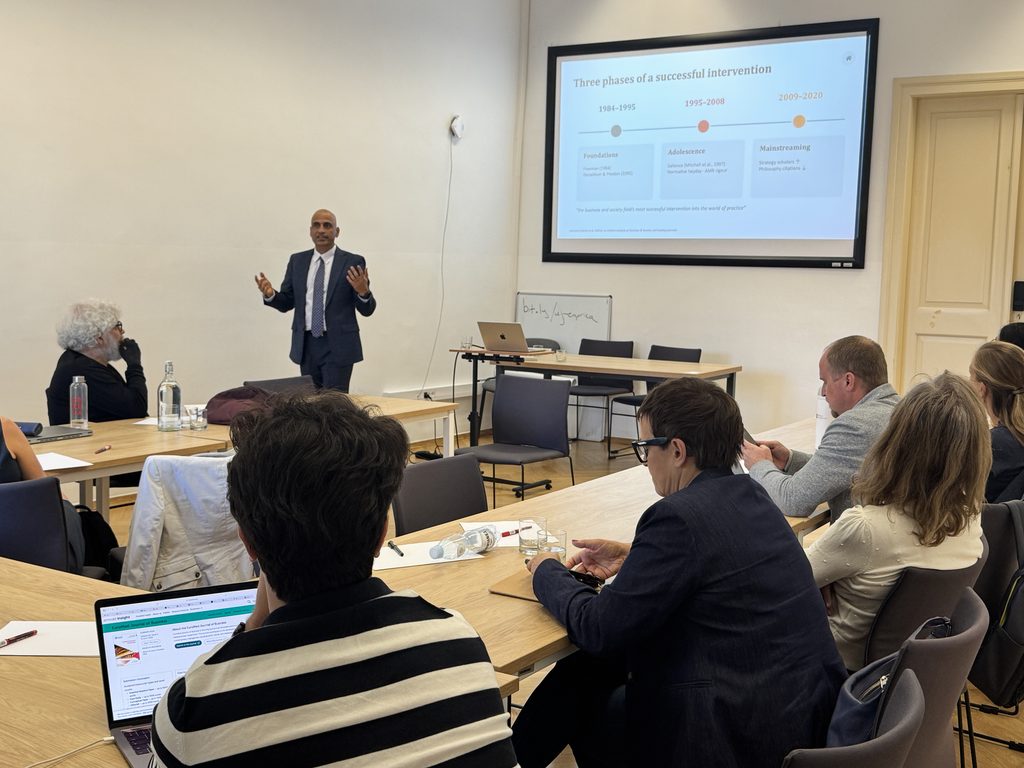
What stakeholder theory paper would you like to read… but hasn’t been written yet?
Ed asked us to start with a title. After guiding us through the history, current debates, and future of stakeholder theory, he made us put our own research questions on the table during an ideation session.
Punit then drew on recent discussions in Business & Society to sharpen the agenda: Who counts? Are the theory’s boundaries expanding? What about its under-theorized dark side? And the challenges of digital transformation, polarization, and democratic backsliding? Questions worth spending a day with. They are the very storms the keynote started from – reframed as research questions.
Plenty of food for thought. A better story, better questions, and the courage to pursue both. That, in short, is what Ed left us with in Kraków.
So what story are you telling yourself?
I keep choosing the better story. I’m optimistic. Ed is, too. Some of you may ask: why be an optimist in times like these? I will let author and speaker Simon Sinek answer that one: “Well, what good is it being an optimist when everything’s perfect?
Now, back to those unwritten papers.
Anna Sławik is an assistant professor at the Faculty of Management and Social Communication, Jagiellonian University in Kraków, Poland. Her research revolves around value creation in a broad sense, as a core purpose of any social system.
References
Cascio, W. F. (2006). Decency means more than “always low prices”: A comparison of Costco to Wal-Mart’s Sam’s Club. Academy of Management Perspectives, 20(3), 26–37, https://doi.org/10.5465/AMP.2006.21903478
Freeman, R. E. (1994). The politics of stakeholder theory: Some future directions. Business Ethics Quarterly, 4(4), 409–421. https://doi.org/10.2307/3857340
Freeman, R. E., Martin, K., & Parmar, B. (2007). Stakeholder capitalism. Journal of Business Ethics, 74(4), 303–314. https://doi.org/10.1007/s10551-007-9517-y